Six Sigma is a framework designed to make an organization more competitive by focusing on being effective and efficient. It is a systematic problem-solving approach centered around defect elimination and variation reduction, leading to process improvement.
Specifically, Six Sigma is a continuous improvement process with a focus on the following:
- Change empowerment
- Seamless training of resources
- Consistent top management support

Six Sigma refers to the practice of delivering products and services that perform at high standards. It is a Quality Philosophy and a management technique. However, it is not a standard, certification, or metric like a percentage.
Six Sigma’s Basic Premises
The purpose of Six Sigma is to satisfy customers by producing quality products. Hence, it focuses on variation reduction and waste elimination. This leads to increased efficiency.
Variation is the range of difference between the statistical mean and all data points that are used to calculate the mean. In other words, the extent to which process performance varies around the mean.
Waste or defects are measurable product characteristics that do not meet the requirements of the customer (i.e. defective products). In other words, any process performance outside of the defined specification is considered waste or a defect.
Six Sigma methodologies are used to identify and remove the root cause of defects or reduce the process variation (using statistical or process analysis methods) and also the costs that are associated with it.
For example, let’s say XYZ factory produces widgets. The widgets are all supposed to be a certain size, shape, and weight. Now, randomly sampled output discovers that out of every 1,000 widgets, fifty are flawed (e.g. wrong size, shape, or weight). To correct this, the factory uses Six Sigma to determine what’s causing the variation/defects and works to reduce them to a six-sigma level.
Six Sigma’s Approach to Problem Solving
The term Six Sigma was first coined by American engineer Bill Smith, who is known as the father of Six Sigma. While working at Motorola in the year 1986, Smith created Six Sigma as a general approach to measuring quality in business performance terms. Later, it became a popular management approach at GE with Jack Welch in the early 1990s.
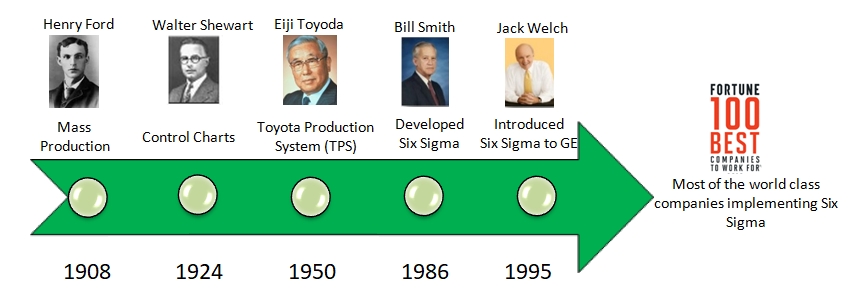
General Electric recognized benefits of $2.5 billion per year due to Six Sigma policies and made it a company-wide strategy. Now, it has become a project-driven approach for process improvements that follows the five-step process, also called the DMAIC cycle. (Also see: History of Continuous Improvement).
What is a Six Sigma Level?
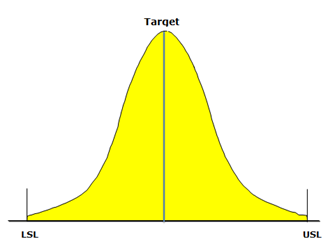
Six Sigma derives from the normal or bell curve in statistics, where each interval indicates one sigma or one standard deviation. Moreover, sigma is a statistical term that refers to the standard deviation of a process around its mean. In a normally distributed process, 99.73% of measurement will fall within ±3σ, and 99.99932% will fall within ±4.5σ.
For a process, the sigma capability is a metric that shows how well that process is performing. Hence the higher the sigma value, the better the process.
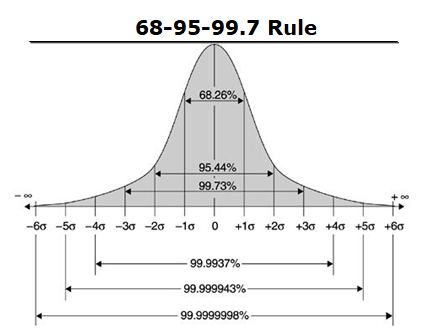
The 68-95-99.7 rule, also known as an empirical rule, is used to remember the percentage of values that lie within a band around the mean in a normal distribution with a width of one, two, and three standard deviations.
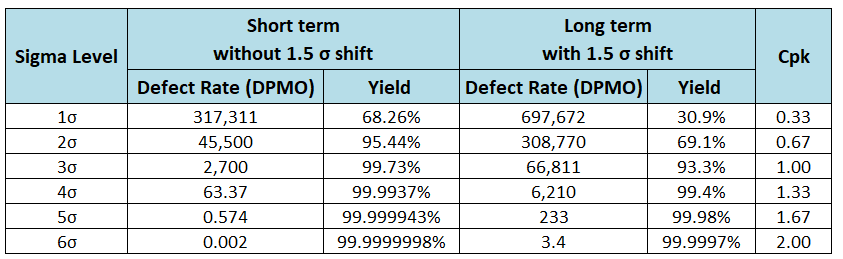
A six sigma capable process will have Cp >= 2.0, Cpk >= 2.0 and DPMO = 3.4
Where Does the 6 and Sigma come from?
Let’s cover Sigma first. Sigma, denoted by the symbol σ (a Greek letter), represents the standard deviation of a population. Primarily, it represents the dispersion (or ‘spread’) of a set of data values with respect to mean. A standard deviation is a value you have to calculate and is dependent on the data your process generates.
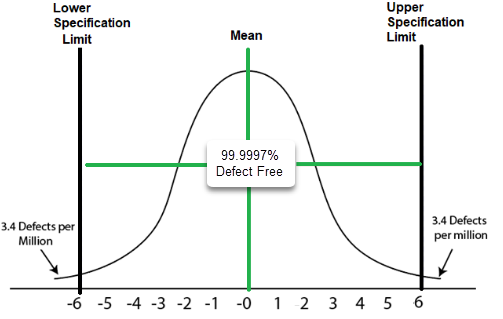
Now let’s cover the 6. The six refers to how many standard deviations away from the mean we set the specification limits in a 6 sigma process.
Now let’s put them together for 6 Sigma: A Six Sigma process has a specification limit that is 6 times its sigma (standard deviation) away from its mean. The 6 refers to the ability to fit the good outputs of the process to fit within 6 standard deviations (or sigmas). Another way to say it is that only 3.4 defects per every million products fall outside the limits we’ve set at 6 sigmas away from the center.
Additionally, you can also think of it as a level of excellence that can be quantified and easily compared against other processes. If you only get 3.4 defects per million out of your process, i.e. a 99.9999998% success rate, you have a 6 sigma process.
Other Sigma Levels
For each standard deviation away from the mean (0 in the graphic above), your process gets more and more defect-free. Let’s look at a 3 Sigma process, for example. In a normally distributed process, if the mean ±3σ range of output is between USL and LSL, then around 99.73% of the points of the output will be non-defective.
The Primary Goals are to Improve
Six Sigma is a data-driven methodology that uses statistical tools and techniques to define the problem and evaluate each process step. In addition, it provides ways to create an efficient business structure, improve the quality of the operations in an organization, and increase the bottom-line profit.
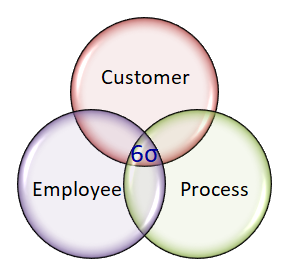
Three Key Elements of Six Sigma
- Customers: Customers are the key to business, and they are the top priority. Customers define the quality requirements and expect on-time delivery, high performance, great service, and many more. However, meeting customer requirements is not enough in the business world.
- Process: Defining the process and important metrics is the key aspect of Six Sigma. Since the customer is key for any business, quality needs to be looked at from the customer’s perspective. This helps to identify the gaps in processes and the work necessary to improve them.
- Employee: Without leadership commitment, using Six Sigma in any organization is difficult. The organization must involve all employees with well-defined roles and clear objectives. Furthermore, organizations must provide required resources like people, training, budget, and more.
Philosophy & Methodology
Six Sigma is a result-oriented, continuous improvement process that includes active involvement from senior management.
Continuous improvement activities in an organization ensure to identify and solve the problems when they occur. Most of the modern quality improvement models, such as sampling techniques, control charts, process capability, and DOE have been influenced by the theory of continuous improvement.
Why Use Six Sigma?
Organizations face new challenges every day, like rising costs, customer issues, an increase in defect rate, etc. In fact, global competition has made it critical to provide perfect quality at a low cost to keep customers happy and to make organizations viable in the marketplace. Some of the key benefits of using Six Sigma include the following:
- Creates robust products and services
- Ensures customer satisfaction
- Reduces process variation and eliminates waste
- Eliminates the root causes of problems and defects in a process
- Reduces rework by getting it right the first time
- Addresses key organization business requirements
- Competitive advantage
Six Sigma Methodologies
Six Sigma provides better value to customers, employees, and all the stakeholders in an organization. Additionally, it is a business initiative that improves quality and productivity and reduces costs.
DMAIC
One of the basic tools in Six Sigma is the use of the DMAIC methodology. (Also see DMAIC Overview). Particularly, DMAIC is a logical framework that helps you think through a process, plan improvements, and achieve a Six Sigma level of quality. In other words, it is a data-driven quality strategy for a better process.
There are five phases in the DMAIC method. They are as follows:
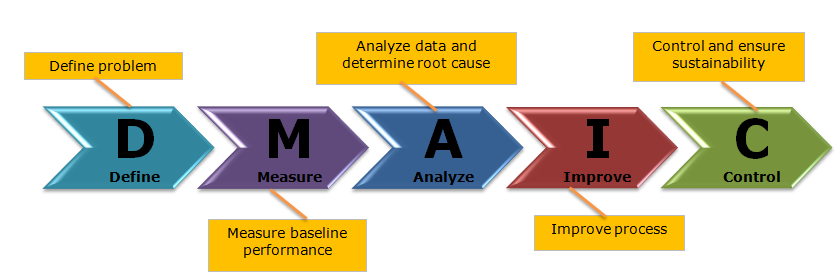
- Define: Define the problem and also project goals that need to be addressed.
- Measure: Measure the baseline performance and confirm the practical problem by collecting data
- Analyze: Analyze the data to determine the root causes of the problems and then identify opportunities for improvements.
- Improve: Improve the process and test the statistical solution.
- Control: Start using a new process for production. Implement, control, and ensure sustainability. Finally, measure the new process based on customer reactions.
Six Sigma teams define the problem, work with sponsors and stakeholders, and deliver results that will be reviewed at phase-gate meetings called DMAIC Tollgate Reviews.
DMADV
DMADV is one aspect of Design for Six Sigma (DFSS). In fact, this evolved from the continuous quality improvement and Six Sigma approach to reduce variation. However, DMADV aims to create new processes and new products or services.
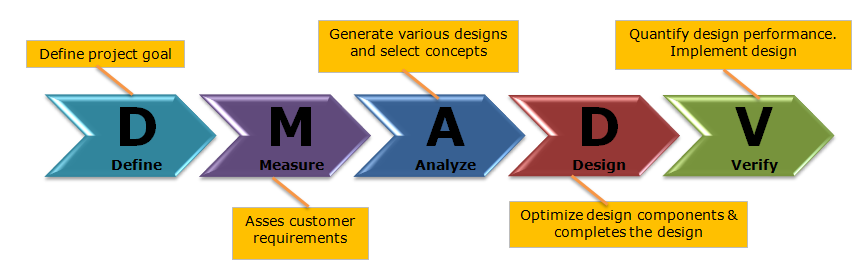
- Define: Determine the project need and also identify the goals
- Measure: Assess customer needs and prioritize requirements
- Analyze: Analyze data, generate various designs, and select concepts
- Design: Optimize design components and completes the design
- Verify: Validate and quantify the design performance.
Six Sigma Frequently Asked Questions
What is the concept of Six Sigma?
Six Sigma refers to the methodology and practice of focusing on developing and delivering products/services that perform at high standards. It is a Quality Philosophy and a management technique. It is a systematic problem-solving approach centered around defect elimination and variation reduction, leading to process improvement.
What are the Five steps of six sigma?
- Define: Define the problem and also project goals that need to be addressed
- Measure: Measure the baseline performance and validate the practical problem by collecting data
- Analyze: Analyze the data to determine the root causes of the problems and opportunities for improvement
- Improve: Improve the process and test the statistical solution
- Control: Start using a new process for production. Implement, control, and ensure sustainability. Finally, measure the new process based on customer reactions.
Why is it called six sigma?
Sigma, denoted by the symbol σ (a Greek letter), represents the standard deviation of a population. Particularly, it characterizes the dispersion (or ‘spread’) of a set of data values with respect to mean.
A Six Sigma process has a specification limit that is 6 times its sigma (standard deviation) away from its mean. In other words, the 6 refers to the ability to fit the good outputs of the process to fit within 6 standard deviations (or sigmas). Another way to say it is that only 3.4 defects per every million opportunities fall outside the specification limits that we’ve set at 6 sigmas away from the center.
What is an example of Six Sigma?
Six Sigma means producing a defect-free product 99.9996% of the time, allowing only 3.4 defects per million opportunities.
What are 6 Sigma tools?
- DMAIC: DMAIC is Six Sigma’s signature framework for process improvement. It provides a structured way of improving a process.
- 5S: 5S Workplace Organization is A visual system. Also, a Kaizen event. 5S derives its name from five Japanese terms beginning with the “s” to create a workplace suited for visual control and lean production.
- Seven Wastes: Seven Wastes are looked at as challenges to productivity. In a highly competitive world, it is not possible to enhance the top line by increasing the prices, hence, it is necessary to build effective systems, and one of the ways is to understand the ‘wastages’ and eliminate them.
- VSM: Value stream mapping provides a visual representation of the flow of materials and information throughout the organization. It helps to identify, demonstrate, reduce waste and finally create effective flow through all the processes in the manufacturing organization.
- Process Map: A process map is a tool that shows the inputs, actions, and outputs of a process in a clear, step-by-step map of the process.
- Voice Of Customer (VOC): Organizations to understand the needs and expectations of the customer to design the product and services well. Moreover, customers will weigh the value of a product based on the cost, quality, availability, and features.
- Kaizen: Kaizen means an improvement on a continuous basis. Originating in Japan, Kai means change, and zen means for good.
Which companies are using Six Sigma?
Six Sigma was coined by Bill Smith, an American engineer who is known as the father of Six Sigma. At the same time, he first implemented Six Sigma at Motorola in the year 1986 as a general approach to measuring quality in business performance terms.
Also, see the companies that have embraced Six Sigma: Motorola, General Electric, Dupont, Sony, Kodak, Boeing, Johnson & Johnson, 3M, Amazon, Atos, Autoliv, BAE Systems, Bank of America, Becton Dickinson, Bechtel, etc.,